
1688 Consolidation: Merge Multiple Sellers into One Shipment
1688 consolidation is the process of collecting orders from several different 1688 sellers at one warehouse in China, then packing them into a single international shipment instead of shipping each parcel separately. You pay one shipping cost for one combined box rather than several shipping costs for several small boxes — which is usually where the real savings are when you buy from more than one supplier. This guide explains exactly how 1688 consolidation works, where the money is saved, what you can and cannot sensibly combine, and how it fits with a 1688 buying agent.
Why Buying from Multiple 1688 Sellers Gets Expensive
1688 is a marketplace of thousands of independent suppliers. Very few of them carry everything you need. A single order might touch a factory in Guangdong for the main product, a packaging supplier in Zhejiang, and a components seller in Jiangsu — each shipping to you separately. Three sellers means three domestic parcels, three international shipments, and three sets of handling fees.
That is the problem consolidation exists to solve. Instead of three international parcels, a consolidation warehouse receives all three domestic parcels, checks them in, and repacks them into one box that crosses the border once. The math is simple, but it changes what an overseas order actually costs.
| Scenario | International parcels | Handling fees | Result |
|---|---|---|---|
| 3 sellers shipped separately | 3 | 3 separate fees | Higher total cost, three tracking numbers to follow |
| 3 sellers consolidated into 1 | 1 | 1 combined fee | Lower total cost, one tracking number |
What 1688 Consolidation Actually Involves
Consolidation is more than just taping two boxes together. A proper consolidation service runs several steps in sequence:
- Receiving. Each seller ships its parcel to the consolidation warehouse’s address in China. The warehouse logs the arrival of every package against your order list.
- Checking in. The warehouse confirms the right number of parcels arrived and records the weight and dimensions of each.
- Holding. Your parcels wait in storage until you say the order is complete and ready to ship, so you are not forced to ship half an order early.
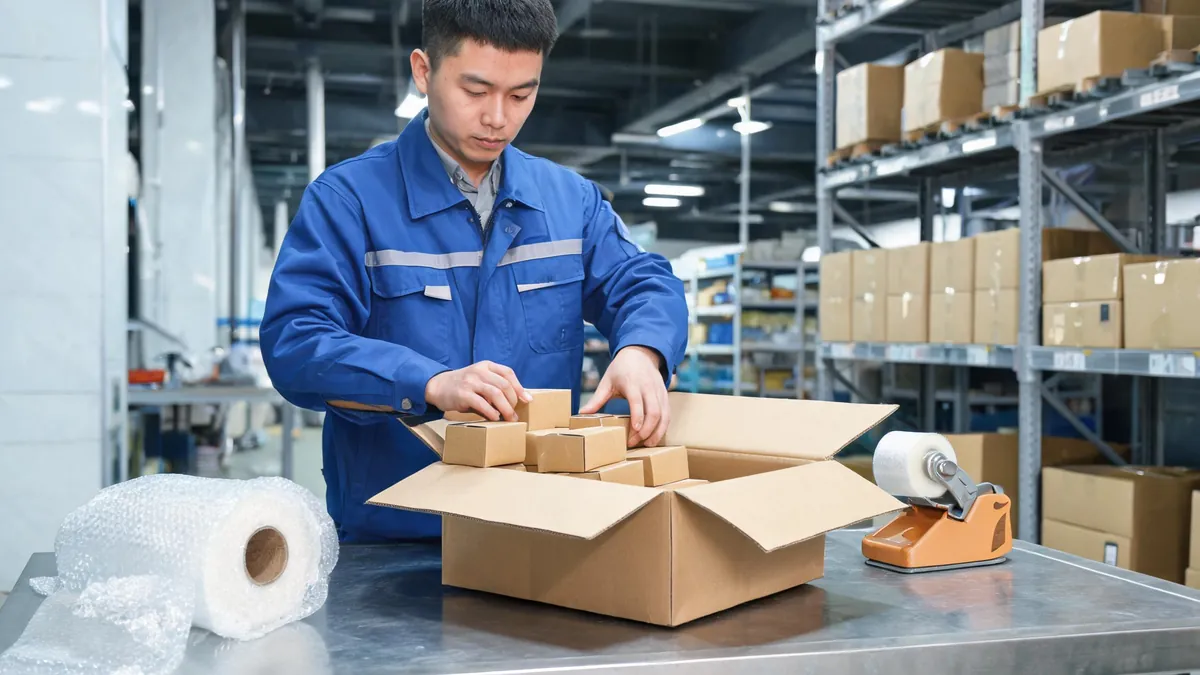
- Repacking. Items are combined into one box, often removing excess seller packaging to cut volume, which lowers the freight charge.
- Shipping. The single combined parcel is dispatched to you by courier, air freight, or sea freight, depending on size and urgency.
What consolidation does not include is factory auditing or formal quality inspection. The warehouse confirms parcels arrived and can, on request, take a photo of the items, but verifying a supplier’s background or running a formal QC inspection is a separate service and sits outside the combine-and-ship flow.
How 1688 Consolidation Works, Step by Step
The flow is straightforward once you see it laid out:
| Step | What happens | What you do |
|---|---|---|
| 1. Place orders | You (or your buying agent) order from multiple 1688 sellers. | Send product links and quantities |
| 2. Ship to warehouse | Each seller sends its parcel to the consolidation warehouse in China. | Share the warehouse address with sellers, or let your agent handle it |
| 3. Arrival and check-in | The warehouse logs each parcel and confirms the order is complete. | Confirm which parcels you are waiting on |
| 4. Consolidation request | You tell the warehouse to combine everything into one shipment. | Approve the combined shipment |
| 5. Repack and weigh | Items are repacked into one box and re-weighed for the freight quote. | Review the final weight and cost |
| 6. International shipping | The single parcel ships and you receive one tracking number. | Track the shipment |
| 7. Delivery | The parcel clears customs and arrives at your door. | Receive and check your order |
What You Can Consolidate (and What You Should Not)
Almost any physical goods from 1688 can be consolidated, but some combinations make far more sense than others. The best candidates are items that are light, durable, and unregulated — packaging, components, accessories, textiles, and general merchandise.
A few combinations are worth thinking twice about. Very fragile goods packed next to heavy items need careful repacking. Items that need special handling, controlled storage, or that carry import restrictions in your country should be checked before you combine them, because one restricted item can hold up an entire box at customs. And if you need a supplier’s goods in a hurry, consolidating them with a slow-moving sea-freight order defeats the purpose.
| Good to consolidate | Think twice before consolidating |
|---|---|
| Multiple small, light orders from different sellers | Fragile goods packed beside heavy, dense items |
| Orders that can wait for the full shipment to be ready | Urgent orders you need immediately |
| Goods with no special handling or import restrictions | Items with import restrictions or controlled handling needs |
| Packaging, components, accessories, textiles | Perishable or temperature-sensitive goods |
How 1688 Consolidation Saves You Money
The savings come from two places, and they are worth understanding separately because they affect different orders.
The first is the base freight minimum. Every international shipment has a floor cost — a minimum charge that applies whether your parcel is 500 grams or 3 kilograms. When you ship three small parcels separately, you pay that minimum three times. Consolidated into one box, you pay it once. This is the biggest saving for small, light orders, which is exactly what many 1688 buyers are placing.
The second is volume. Freight is priced by actual weight or volumetric weight, whichever is higher. Seller packaging is often bulky — a large box with a small item and a lot of padding. Repacking several orders into one box removes that excess volume, which lowers the chargeable weight and the price you pay.
| Cost driver | How consolidation helps |
|---|---|
| Base freight minimum per parcel | Paid once instead of once per seller |
| Volumetric weight | Reduced by repacking into one tighter box |
| Handling and pick-up fees | One combined fee instead of several |
| Tracking and coordination | One shipment and one tracking number to manage |
The actual saving depends on how many sellers you are combining, how heavy and bulky the goods are, and where they are going. There is no fixed “consolidation saves X percent” number that holds for every order, so the reliable way to judge is to ask for a quote with and without consolidation for your specific order list. Actual savings are confirmed at the time of inquiry.
A Simple Worked Example of the Savings
The clearest way to see how consolidation changes the price is to run a rough scenario. Imagine you are buying from four different 1688 sellers, each sending a small parcel of roughly 800 grams to 1 kilogram. Shipped separately, each parcel pays its own base freight minimum plus its own handling fee. Combined into one shipment, you pay one base charge and one handling fee, and the repacking often trims the total volume enough to lower the chargeable weight as well.
| Approach | Parcels | Base charges | Handling fees | Net effect |
|---|---|---|---|---|
| Shipped separately | 4 | 4 | 4 | Highest cost, four tracking numbers to follow |
| Consolidated into one | 1 | 1 | 1 | Lower cost, one tracking number |
This is a simplification, not a quote. Real freight quotes also turn on the destination, the exact weight and dimensions of the combined box, and whether you ship by courier, air, or sea. The point is the structure: consolidation removes the duplicated per-parcel charges, and those duplicates are often the dominant cost for small orders. To see the real number for your goods, ask for a with-and-without-consolidation quote.
1688 Consolidation vs Freight Forwarding
People often blur these two because they both touch international shipping, but they solve different problems. A freight forwarder moves goods that are already yours and already packed; a consolidation service combines goods from several suppliers into one shipment before it is dispatched.
| Factor | Consolidation service | Freight forwarder |
|---|---|---|
| Core job | Combine parcels from several sellers into one shipment | Move a shipment from A to B |
| Works with | Multiple 1688 suppliers at once | Goods you have already assembled or sourced |
| Typical user | Buyers sourcing from several 1688 sellers | Importers with a defined, packed shipment |
| Value | Cuts cost by merging parcels and repacking | Handles freight booking and customs paperwork |
In practice, a 1688 buying agent that also offers consolidation bridges the two: it buys from your sellers, gathers everything at its warehouse, combines the parcels, and then arranges the freight. That is the end-to-end flow most overseas buyers actually want, because they do not want to manage a warehouse and a forwarder separately.
Storage and Holding: The Invisible Step
One part of consolidation that buyers rarely think about until it matters is storage. Your parcels do not all arrive at the warehouse on the same day — a seller in Guangdong might ship in two days while a seller in Jiangsu takes a week. The warehouse holds the earlier parcels until the last one arrives, so you can combine everything into one shipment. That holding period is normally free for a short window, after which storage fees may apply.
This is why the timing of your orders matters. If one supplier is slow, your entire consolidated shipment waits for it, and any storage fee is quietly added to the bill. Ask your consolidation partner up front how long parcels are held free of charge and what the storage fee is after that. A clear answer tells you whether it is better to ship a partial order now or wait for the full order to combine.
How a 1688 Buying Agent and Consolidation Fit Together
Consolidation is rarely a standalone purchase. It usually runs hand-in-hand with a 1688 buying agent, because the agent is already placing your orders and receiving the goods. When one partner handles both buying and consolidation, you get a single point of contact for the whole flow — from the product links you paste to the single parcel that arrives at your door.
This matters more than it sounds. If you buy directly from 1688 sellers yourself, you still need to arrange a consolidation warehouse address, tell each seller where to ship, and then coordinate the combined shipment. A buying agent removes that coordination entirely. For a fuller picture of the direct route, see our guide to how to buy from 1688 on your own.
Choosing a Consolidation Partner
Not every consolidation service is the same, and the differences show up when something goes wrong. Before you send your goods, check a few basics:
- A real warehouse address in China. A legitimate service receives goods at a physical location, and can confirm arrivals against your order list.
- Transparent repacking. You should be able to see the weight and dimensions before and after repacking, so the freight charge is explainable.
- Written storage terms. How long will parcels be held before fees apply, and what are those fees? It should be in writing.
- Clear arrival confirmation. The warehouse should tell you what arrived and what is still missing, not leave you guessing.
- Trackable shipping. You should receive a tracking number for the combined shipment, not a vague status update.
- Clear repacking options. Some buyers want excess packaging removed to save freight, others want to keep it for protection. You should be able to choose.
- Consolidation timing. The service should let you decide when to consolidate — when the order is complete, not on a fixed schedule that forces half your order to ship early.
Common 1688 Consolidation Mistakes
A few mistakes come up repeatedly, and they are all avoidable:
- Shipping before everything arrives. If you consolidate too early, you pay for a second shipment when the remaining parcels arrive. Wait until the order is complete.
- Mixing restricted goods. One restricted or prohibited item can delay or hold the entire combined box at customs. Confirm restrictions before you consolidate.
- Ignoring volumetric weight. Bulky but light items can be expensive to ship even when consolidated. Repacking helps, but it cannot remove all volume.
- Not comparing the freight options. Courier, air, and sea have very different prices and speeds. The cheapest option is not always the best for your timeline.
- Combining fragile and heavy items without care. Ask for protective packing when your order mixes delicate and dense goods in one box.
None of these are fatal, but each one quietly eats into the savings consolidation is supposed to create.
When Consolidation Is Not Worth It
Consolidation is powerful, but it is not always the right answer. If you are buying from a single 1688 seller, there is nothing to combine — you are just paying for shipping, and a good China buying agent or a straightforward shipping service is the cleaner fit.
Consolidation also adds a step and a little time. If you need one item urgently and it is ready before the rest of your order, shipping it immediately may beat waiting to combine. And for very large, heavy orders where freight is dominated by weight anyway, the marginal benefit of merging a few parcels is smaller. The decision comes down to one question: are you shipping several small parcels, and can they wait to travel together?
Consolidation, Duties, and Destination Compliance
Combining parcels changes your shipping cost, but it does not change how import duties and taxes work. Every item inside the consolidated box is still subject to the import rules of the destination country, based on its own classification and declared value. In fact, consolidation can make duty handling slightly cleaner, because you deal with one shipment and one set of documents instead of several.
That said, destination duties and taxes are the buyer’s responsibility, and the exact amount depends on the destination country’s rules, the goods, and their value. No consolidation service can guarantee a duty figure before the goods clear customs. If you are unsure about the rules for a specific item, confirm them with your destination customs authority or a licensed broker before you ship. The same goes for restricted or controlled items — checking them up front avoids one item holding up the entire combined box.
Frequently Asked Questions
Can I combine orders from different 1688 suppliers into one shipment?
Yes. That is exactly what consolidation is for. Each supplier ships to one warehouse in China, and the warehouse combines all the parcels into a single international shipment so you pay one freight charge instead of several.
Is consolidation the same as using a freight forwarder?
Not exactly. A freight forwarder moves goods you have already packed, while a consolidation service combines parcels from several suppliers into one shipment before dispatch. Many buying agents offer both, so the two often overlap in practice.
Getting Started with 1688 Consolidation
Before you ask for a consolidation quote, gather your product links and quantities, and have a sense of how heavy and bulky the order is likely to be. The clearer your order list, the more accurate the quote — and the easier it is to compare the consolidated price against shipping each parcel separately.
Combine Your 1688 Orders Into One Shipment
Send us your 1688 links and we will quote the full order — buying, consolidation, and international shipping — as one combined cost, so you can see what you save before you pay. Our warehouse receives your parcels, repacks them into a single shipment, and dispatches it to your door.
See our consolidation and shipping options · or get a consolidation quote.