
Pet Supplies Sourcing from 1688: What to Check
Pet supplies are one of the most underrated categories on 1688. The platform is packed with dog beds, cat towers, feeding bowls, leashes, grooming tools and chew toys at prices that routinely run 40 to 60 percent below what Western wholesalers quote. The problem is that a low price means nothing if the product fails a customs check, offends a buyer with a chemical smell, or lands you in a safety recall. That is why smart importers treat pet supplies sourcing from 1688 as a checklist exercise, not a bargain hunt. In this guide we walk through every check that matters, from certifications and materials to MOQs, packaging and what happens after your order leaves the factory. If you get these checks right, the category can become a steady margin engine for your store. If you skip them, you are gambling with returns, refunds and your seller account.
Why Pet Supplies Are One of the Strongest 1688 Categories
The pet industry keeps growing even when other retail categories stall. Owners keep spending on their animals during downturns, and most pet goods are consumable or replaceable: beds flatten, toys get destroyed, leashes wear out. That recurring demand is exactly what wholesale sourcing is good at serving. 1688 in particular concentrates the supply side. The factories that private-label pet products for Amazon, Chewy and big-box stores are, in many cases, the same factories that run storefronts on 1688.
There are three practical reasons the platform works so well for this niche. First, the choice is enormous. A search for a single item such as a slow feeder bowl returns dozens of mold variations, materials and price tiers, which makes it easy to compare specifications rather than settle for one supplier’s catalog. Second, customization is cheap at low volumes. Pet products are small and lightweight, so printing a logo on a nylon leash or embroidering a brand on a plush bed costs far less than customizing furniture or electronics. Third, margins travel well. A pet product that costs two dollars at the factory often retails for twelve to fifteen dollars in North America or Europe, leaving room for freight, duties and a solid markup even after all costs are counted.
The catch is that the same characteristics that make the category attractive also create risk. Small soft goods are hard to inspect from photos, safety rules for pet products vary by market, and the low entry price attracts beginners who skip due diligence. The rest of this guide is about closing that gap.
Which Pet Product Lines to Source on 1688
Not every pet subcategory is equally friendly to an overseas buyer. Some lines are ideal for a first order; others should wait until you have an inspection process in place. The general rule is that fabric, plastic and stainless steel items with simple shapes are the safest starting points, while anything that touches an animal’s mouth for long periods, or anything with electronics or moving joints, needs more care.
Dog beds and cat beds are among the best entry products. They are soft goods with few compliance requirements, they compress well for shipping, and the price gap between 1688 and Western wholesale is dramatic. What you check is mostly physical: foam density, cover fabric, stitching strength and whether the zipper is hidden so a dog cannot chew it. Blankets, mats and crate covers follow the same pattern and are often made in the same factories.
Feeding bowls and slow feeders come next. Stainless steel bowls are cheap, durable and easy to inspect; the main checks are steel grade, wall thickness, and whether the non-slip rubber ring is glued or over-molded. Plastic slow feeders need more attention because the material grade matters: cheap recycled plastic can carry an odor, warp in a dishwasher and even crack under a determined dog. Always specify food-grade, BPA-free material in writing before you pay a deposit.
Leashes, collars and harnesses are excellent for private labeling, but they are also the category where a failure hurts a customer directly. A leash that snaps on a busy street is a real safety incident. Your checks here are hardware strength, stitching patterns (box stitches and bar tacks, not a single seam), buckle load rating, and whether reflective stitching actually uses reflective thread. Pet clothing follows similar logic with one extra dimension: sizing. Chinese sizing charts for pet apparel run smaller than Western buyers expect, so you must confirm the measurement table and ideally grade up one size band.
Toys and chews are the classic volume category, and also the easiest place to get hurt. Rubber and rope toys need third-party test reports for heavy metals and phthalates if they will be sold in the EU or the UK. Anything labeled edible, such as rawhide or dental chews, crosses into food territory and carries import restrictions in several countries, so beginners are usually better off avoiding edible chews entirely. Cat trees and scratching posts are heavy and bulky, which makes freight the deciding cost; they can still be profitable, but only if you consolidate and ship by sea.
Grooming tools, litter boxes, pet carriers and slow-drip water dispensers round out the practical list. Each has its own small compliance world, which the next two sections cover in detail.
Compliance and Certification Checks Before You Order
Compliance is where most first-time pet importers fail, and the failure is usually silent: the goods arrive, they clear customs, they go on sale, and then a marketplace flags the listing or a test comes back and the batch is destroyed. The cheapest way to avoid that sequence is to ask the right questions before a single unit is produced.
Start by deciding which market the goods must satisfy, because the requirements are genuinely different. For the United States, there is no single federal “pet product certificate,” but the Consumer Product Safety Commission enforces rules that matter for your stock: lead limits in surface coatings and substrates, phthalate limits for children’s-adjacent products, and general safety for anything marketed to animals. ASTM F963 is technically a toy standard, but many Amazon sellers ask for it anyway because it is a familiar, well-understood test battery for chemical and physical safety. For the European Union, the relevant framework is the General Product Safety Regulation backed by EN standards for pet articles, with REACH restricting heavy metals and phthalates and specific rules applying to anything a pet ingests. The United Kingdom has kept close equivalents post-Brexit. Australia and Canada are broadly similar but never assume: check the current rules for your specific product type.
Your job is not to become a compliance lawyer. It is to ask the supplier for evidence and to verify that evidence exists. A genuine factory that exports to Western markets will be able to produce test reports from an accredited lab such as SGS, Intertek, TUV or Bureau Veritas, with a report number, a product description that matches your SKU, a date within the last two to three years, and the testing standard clearly stated. A report from an unknown lab with no standard listed, or a report for a different product, is worth roughly nothing.
There is also a documents check that runs parallel to product safety. Every shipment needs a commercial invoice and packing list that match what is actually in the boxes. For soft goods you will also want the material composition breakdown so you can answer a customs officer’s questions about fiber content. If your brand is going on the product, confirm the supplier has the right to use that trademark in your market, which usually means registering the mark yourself rather than relying on the factory’s claim. None of this is complicated; it is just a list of files you collect before production starts, and it is far cheaper to collect them now than to reconstruct them during a customs hold.
Material Safety: What to Check on Every Product
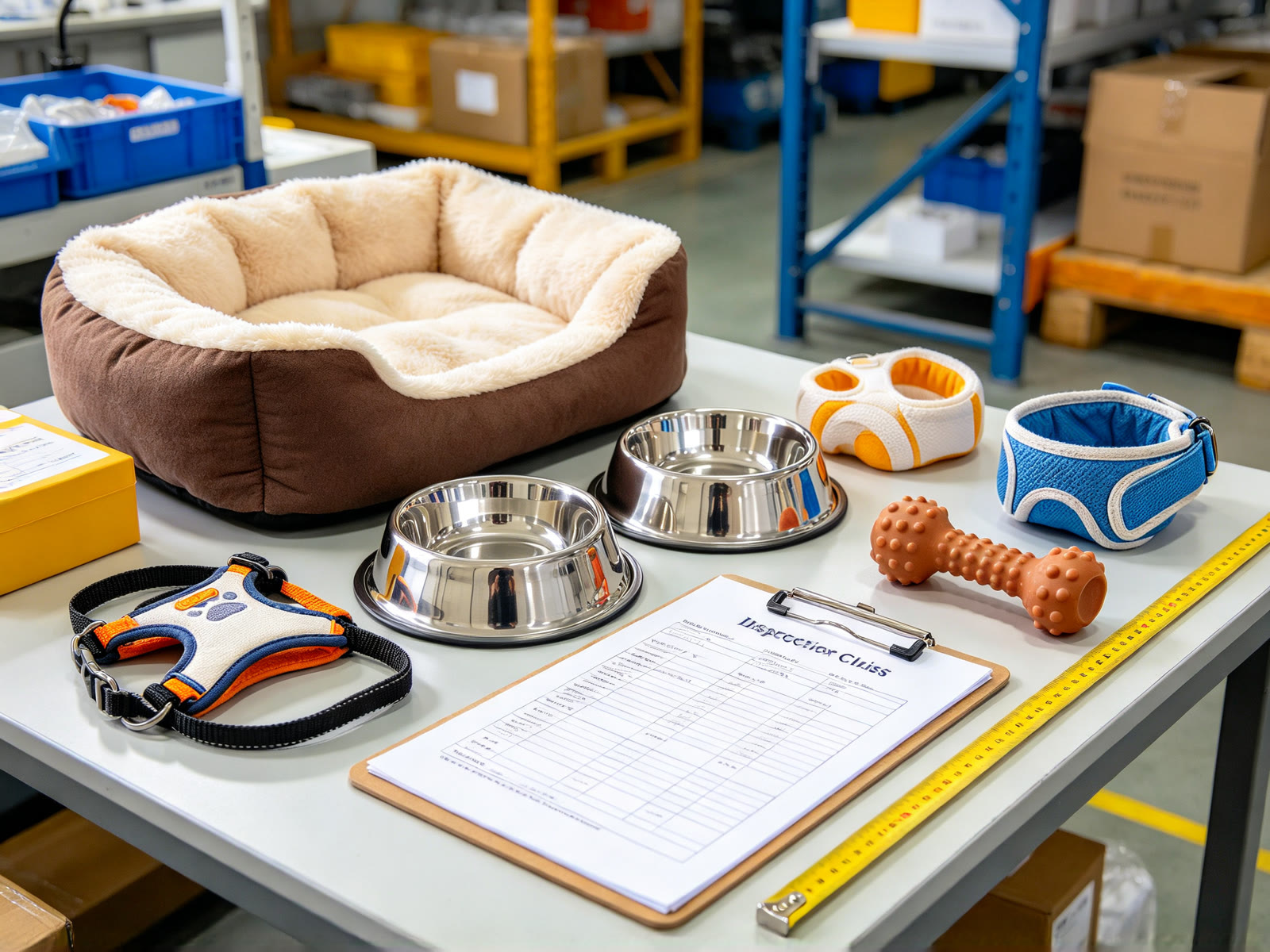
Compliance is about paperwork and test reports. Material safety is about what the customer can see, smell and feel when the box is opened. Buyers forgive a late shipment; they rarely forgive a product that smells like chemicals or leaves dye on their dog’s fur. Your pre-order checks should cover material grade, odor, fasteners and finishing for every SKU.
For textiles, specify the exact fabric and filling in the order contract. A plush dog bed should state the outer fabric composition, the fiber content of the filling and the foam density rather than a vague “high quality.” Ask for a swatch or a pre-production sample and keep it as the reference standard for the whole production run. Pay attention to colorfastness, because a bright red bed that bleeds dye onto white carpet is a return generator; reputable factories test for this and will tell you which dye processes they use.
For plastic parts, the single most useful phrase in your order message is “food-grade, BPA-free, non-toxic, no recycled material.” It costs a few cents more per unit and it removes the largest single source of complaints. Also check wall thickness on molded items: thin, flexible plastic bowls and litter boxes crack in transit and arrive damaged. For rubber and TPE toys, ask which plasticizers are used. Cheap phthalate plasticizers are the classic cost-cutting shortcut, and they are exactly what EU test reports will flag.
For hardware, the checks are about load and corrosion. Buckles, D-rings and clasps on leashes and harnesses should be zinc alloy or stainless steel rather than painted iron, which rusts after a few rainy walks. Snap hooks should have a spring that returns crisply; a loose spring means the hook can open in use. Rope toys should use natural cotton or jute without loose fibers that can be swallowed, and any sewn seam on a toy should be double-stitched with the thread ends buried inside the seam rather than hanging free.
Odor is the check that no document captures. Ask the factory whether materials are aired before packing, and state in the contract that goods must be packed dry and odor-free. Goods that are packed hot and sealed immediately can develop a “factory smell” that buyers describe as chemical, and once the smell is in a plush or foam product it is very hard to get out. A buying agent with a local warehouse will open cartons, photograph the contents and flag this before the goods are consolidated and shipped, which is one of the strongest practical arguments for not buying blind.
MOQ, Samples and Price Checks That Save You Money
1688 minimum order quantities for pet supplies are friendlier than most people expect. Generic dog toys and simple bowls often carry MOQs of fifty to a few hundred pieces, and many factories will accept a trial order of one carton for a small premium. Customized or private-label lines move the bar up, typically to five hundred or a thousand pieces for printed fabric, molded logos or custom packaging. The key is to ask about the MOQ for the exact specification you want, because the published MOQ is usually for the stock product, not for your version of it.
Always order samples before bulk, and always pay for them properly rather than asking for freebies. A paid sample order changes the supplier’s incentive: they are now selling you a product, not doing you a favor, and they will send a better item. Order the sample in the exact color, material and size you plan to sell. When it arrives, measure it against the listing dimensions, weigh it, wash it if it is washable, and photograph everything, because those photos become your reference for quality inspection before shipping.
The price check has two layers. The first is comparing the unit price across two or three factories for the same specification; differences above twenty percent usually mean a different material grade, so push the cheaper factory to confirm the specification in writing before you celebrate. The second layer is the landed cost, which is where beginners lose money. A pet bed that costs three dollars at the factory can easily cost six dollars by the time domestic freight, consolidation, international shipping, duties and last-mile delivery are added. Before you commit to a product, calculate the landed cost per unit and confirm the retail margin still works. Products with a large volume-to-weight ratio, such as unstuffed dog beds, ship as volume rather than weight, which changes the freight math entirely.
Packaging, Labeling and Import Documentation Checks
Packaging decisions get made too late in almost every pet order. The supplier defaults to a plain polybag or a thin retail box, and the importer discovers the problem when the goods arrive compressed, scratched or crushed. State your packaging requirements before production starts: polybag thickness, whether beds are vacuum-compressed and how they recover, whether bowls are individually wrapped to prevent scratching, and whether retail packaging needs a barcode, an SKU sticker and a country-of-origin mark.
Labeling rules deserve their own checklist because they differ by market and by product type. Most countries require a country-of-origin statement on the product or its immediate packaging. Textile products in the US need fiber content and care labels; the EU has its own textile labeling rules; pet food and treats have an entirely separate and much stricter regime, which is another reason beginners should avoid edible lines. If you sell on a marketplace, the platform has its own requirements on top, such as Amazon’s barcode and transparency programs. Write the label text yourself, send it to the factory as a file, and approve a printed sample before the full run. Factories will happily print whatever text you send; the mistakes are almost always on the buyer’s side.
On the documentation side, the two files that matter most at the border are the commercial invoice and the packing list, and they must agree with each other and with reality. The invoice value should be the transaction value, the HS code should be a real and correct code for your product type, and the packing list should match carton counts and weights. Under-declaring value to save duty is a false economy: customs officers see pet goods constantly, and a suspiciously low value invites inspection, storage fees and penalties that dwarf the duty saved. A freight forwarder or a cnb2bgo buying agent can prepare or review these documents before the goods ship, which removes the most common cause of clearance delays.
How a China Buying Agent Runs These Checks for You
Everything above is doable on your own, but it is a second job: messaging factories across a time zone, chasing test reports, ordering and approving samples, verifying materials, and arranging inspection before your balance payment is released. This is where a buying agent changes the economics of pet supplies sourcing from 1688. The agent reads the listings in Chinese, negotiates the deposit and balance terms, orders samples in the specification you confirmed, and physically checks the goods in a local warehouse before they are consolidated and shipped.
The most valuable service in the pet category is pre-shipment inspection. Because pet products are small and soft, the failure modes are visual and tactile: wrong filling density, loose stitching, thin plastic, a chemical smell, a color that drifted from the approved sample. A local inspector can photograph cartons, compare the bulk goods against your approved sample, weigh a random selection, and catch the problem while the goods are still in China, where a rework is possible and the deposit still gives you leverage. Once the goods are on a ship to Los Angeles or Rotterdam, the same problem costs you return freight or a write-off.
A full-service agent also handles the parts of the process that a solo buyer usually botches: consolidating orders from several pet suppliers into one shipment, booking the freight leg at a rate a one-off shipper cannot get, preparing the invoice and packing list, and chasing the supplier if something is short-shipped. If this is your first time in the category, pairing your own checklist with an agent’s execution is the setup that produces a sellable batch on the first attempt. You can read more about the full workflow in our guide on quality inspection before shipping and how checkpoints protect your order.
Frequently Asked Questions
Are 1688 pet supplies safe to sell in the US, EU and UK?
Yes, provided you verify compliance for your market and product type. Pet goods are regulated as general consumer products in most jurisdictions: the US enforces lead and phthalate limits through the CPSC, the EU applies the General Product Safety Regulation with EN standards and REACH, and the UK keeps equivalent rules. Ask the factory for accredited lab test reports for your exact SKU, and confirm the tests are current. A buying agent can translate the reports and check that the certificate actually covers the product you ordered.
What certificates should I ask a pet supplier for?
The certificate set depends on the product. For textiles, request fiber composition and care labeling support plus colorfastness evidence. For plastic and rubber items, request food-grade material declarations, BPA-free statements and phthalate and heavy metal test reports. For anything a pet ingests or chews extensively, request the relevant toy-standard battery, commonly ASTM F963 or the applicable EN 71 parts. Always check that the report’s product description matches your SKU and that it comes from an accredited laboratory.
Can I private label pet products from 1688?
Yes, and pet products are one of the friendliest categories for it. Printed fabric, embroidered logos and custom hang tags are all achievable at MOQs of roughly five hundred to a thousand pieces depending on the item. Send the factory a vector logo file, define placement and color in a specification sheet, and approve a pre-production sample before the run. Register your trademark in your selling market first so the factory’s printing does not create a mark you do not own.
What is the typical MOQ for pet supplies on 1688?
Generic items such as basic dog toys, stainless bowls and simple grooming tools often start at fifty to two hundred pieces, and many factories accept a one-carton trial order for a small surcharge. Customized items move the bar to five hundred to a thousand pieces because the factory must set up printing or molds. Always confirm the MOQ for your exact specification in writing, since the published MOQ usually describes the stock product.
How do I check a pet toy for choking and safety hazards?
Check small parts first: eyes, bells and squeakers must be firmly attached or embedded so a dog cannot pull them off. Confirm no part can break into pieces small enough to swallow. For rubber toys, request phthalate and heavy metal tests and squeeze the material; it should rebound without a chemical odor. For rope toys, confirm natural fiber without loose strands. A pre-shipment inspection should re-check a random sample against your approved reference sample.
Do 1688 pet suppliers ship internationally?
Most 1688 sellers do not handle international logistics themselves, because the platform is designed for the Chinese domestic market. The standard route is to have a freight forwarder or buying agent collect the goods from the factory, consolidate them with other orders, and ship to your country by sea or air. That is also the point where quality inspection happens, so choosing an agent with a local warehouse gives you a check window between the factory and the ship.
What pet categories should beginners avoid on a first order?
Avoid edible products such as treats, rawhide and dental chews, because they fall under food and agricultural import rules that vary by country and can hold an entire container. Also delay anything with batteries or electronics, heavy custom molding, or strict weight-bearing safety claims, such as large elevated beds and car restraints. Start with textiles, stainless steel bowls and simple rubber toys, where the compliance surface is small and the inspection checks are visual and tactile.