
Door to Door Shipping from China: DAP vs DDP Explained
Door-to-door shipping from China means the freight company collects your goods at the supplier or a warehouse in China and delivers them to a physical address abroad, handling the trucking, customs clearance and final-mile delivery along the way. The single thing that changes your price and responsibility is which party pays the import duties: DDP includes them in one all-in price, while DAP delivers to your door but leaves the duties to you. There are three realistic ways to get a door-to-door shipment — express courier, air freight with a door-to-door add-on, and sea freight with a door-to-door add-on — and the right one depends on how fast you need it, how much weight you are moving, and how comfortable you are dealing with customs yourself.
What “door to door” actually includes
A port-to-port quote stops at the destination port, leaving you to clear customs and arrange the last leg yourself. A door-to-door quote carries the shipment through every step to your address. When you are comparing quotes, make sure the door-to-door price actually covers all of these:
- Collection. Picking up the goods from the supplier’s factory or from a consolidation warehouse.
- Export clearance. The paperwork and customs filing on the China side.
- Main carriage. The air or sea leg from China to your country.
- Import clearance. Customs filing at the destination, including duties and tax where applicable.
- Final-mile delivery. The truck from the destination airport or port to your door.
If any one of those is missing from a “door to door” quote, you are actually being sold port-to-port with extra steps, and you will find out about the gap at the worst possible moment — when your goods are sitting in customs.
DAP vs DDP vs DDU: who pays the duties
These three terms decide who is responsible for duties, tax and final delivery, and they are the reason two “door to door” quotes can be hundreds of dollars apart.
| Term | Meaning | Who pays duties & tax | Who delivers to the door |
|---|---|---|---|
| DAP | Delivered at Place | Buyer (you) | Seller / carrier arranges to your address |
| DDP | Delivered Duty Paid | Seller / agent includes them | Seller / carrier to your address |
| DDU | Delivered Duty Unpaid (older term) | Buyer (you) | Delivered to your door, duties unpaid |
DDP is the cleanest option for a first-time buyer: you pay one number and the shipment lands at your door with nothing extra. The downside is you are paying for certainty — the agent builds a duty estimate into the price. DAP is usually cheaper on paper but hands you the duty bill and the customs interaction. DDU is an older term that largely overlaps with DAP in everyday use, so if someone quotes DDU, treat it as “duties are on you.”
Your three door-to-door options
Door-to-door is a service layer that sits on top of a transport mode, not a mode of its own. You are really choosing between courier, air freight and sea freight, then adding the door-to-door service.
| Option | Speed | Cost for small parcels | Best for |
|---|---|---|---|
| Express courier | Fastest, roughly days | Highest per kg | Small, light, urgent or high-value orders |
| Air freight + door | Fast | High per kg, cheaper than courier at weight | Heavier orders that still need speed |
| Sea freight + door | Slowest, weeks | Lowest per kg, but minimums apply | Bulky, heavy or cost-sensitive orders |
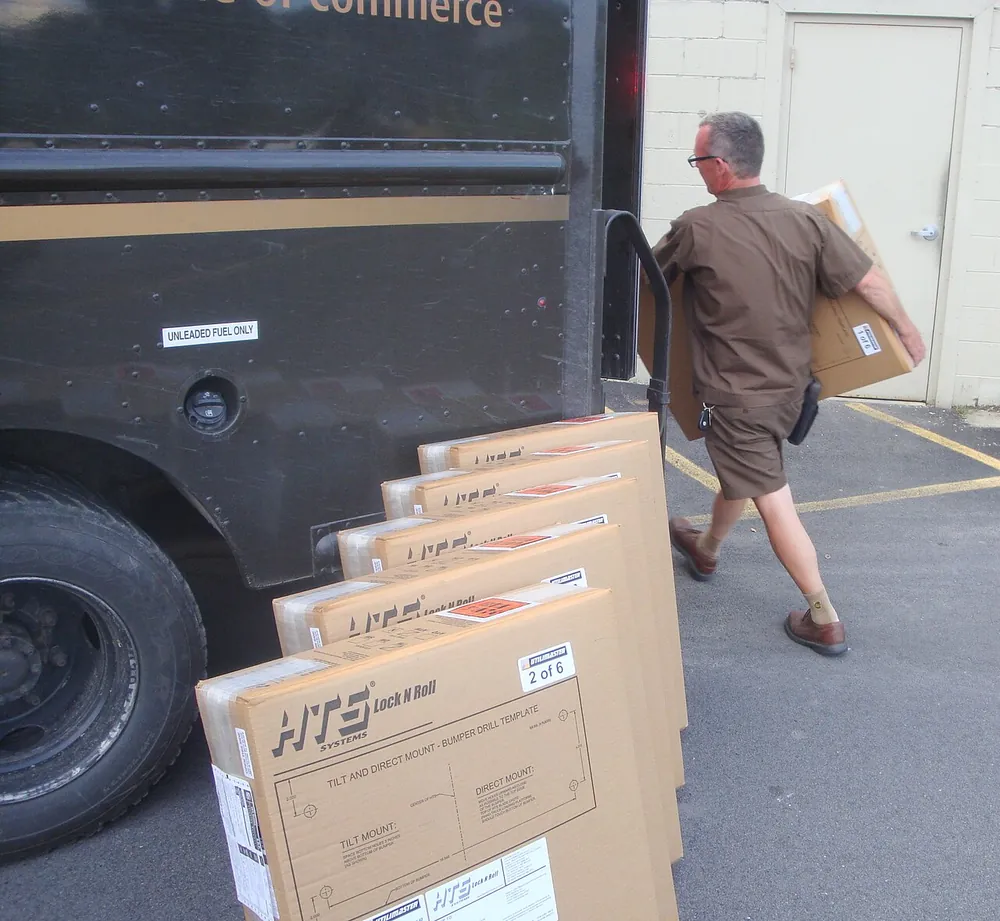
Express courier is the easiest because it is door-to-door by default — FedEx-style services clear customs and deliver to your address with almost no input from you. Air and sea freight, by contrast, are normally port-to-port, and the door-to-door part is added by a freight forwarder or buying agent who arranges the destination customs broker and final truck.
How volumetric weight changes your price
Air and courier freight are priced on volumetric weight, not actual weight. The carrier measures your box, converts its size into a “weight equivalent,” and charges you the greater of the two. This is why a light but bulky package can cost far more than you expect.
The formula is length × width × height (in centimeters) divided by a divisor — commonly 5000 for express couriers and 6000 for air freight. A box that is 40×30×20 cm has a volume of 24,000 cm³, which becomes 4.8 kg of volumetric weight at a 5000 divisor, even if the actual goods weigh only 2 kg. You pay for 4.8 kg.
This is also the quiet argument for consolidation and repacking. When a buying agent combines several suppliers into one well-packed carton and trims the empty space, it cuts the volumetric weight directly, which is often worth more than any fee negotiation. It is why the packing step matters as much as the shipping quote itself.
How the door-to-door process works step by step
Understanding the sequence matters because each step is a place where a cheap quote can fall apart. A properly managed door-to-door shipment looks like this:
- Goods arrive at a consolidation point. If you bought from several 1688 suppliers, the parcels are combined in one warehouse first. Combining them is what makes international shipping affordable — see our guide to 1688 consolidation.
- Export paperwork is filed. A commercial invoice with accurate values and a clear description is prepared. Errors here are the number one cause of customs delays.
- Main carriage. The goods fly or sail to your country.
- Import clearance. A customs broker files entry documents and, under DDP, pays the duties and tax on your behalf.
- Final mile. A local carrier takes the goods from the airport or port to your door and gets a signature.
The value of a buying agent or forwarder here is owning the hand-offs. When the trucking, customs broker and courier are three separate vendors, responsibility falls between the cracks; when one party owns the whole chain, problems get resolved instead of bounced around.
Documents you need for door-to-door shipping
Door-to-door shipping is only as smooth as its paperwork. The carrier and the destination broker need a few standard documents, and getting them right up front is what keeps a shipment from stalling in customs.
- Commercial invoice. The seller’s invoice listing what you bought, the quantity, and the value. The value and description here drive the duty calculation, so they must be honest and specific — “electronics parts” is safer than “gift” or “samples” when it is not actually a gift or sample.
- Packing list. A breakdown of what is in each carton: weights, dimensions and contents. This is what the carrier uses for the volumetric calculation.
- Air waybill or bill of lading. The carrier’s contract of carriage, issued once the goods are booked.
- HS code. The tariff classification for your product, which determines the duty rate. A buying agent or forwarder usually assigns this, but you should confirm it makes sense for what you are actually importing.
- Any product-specific documents. Certain goods — electronics with batteries, cosmetics, some machinery — may need extra declarations. Ask your agent up front whether your product falls into a restricted category.
The recurring theme is accuracy. Understating a value to “save” duty is a false economy: it invites penalties, delays and re-invoicing at the border, and it shifts compliance risk onto you, the buyer.
What drives the price
Door-to-door pricing is calculated from several components, and knowing them is how you spot a padded quote.
| Component | What it depends on |
|---|---|
| Weight & volume | Charged on the greater of actual weight and volumetric weight (for air and courier) |
| Transport mode | Courier highest, air mid, sea lowest |
| Distance & destination | Remote areas carry surcharges; some countries cost more to clear |
| Duties & tax | Your country’s tariff on that HS code, plus VAT/GST |
| Fuel & surcharges | Fluctuate constantly and seasonally |
Two rules matter more than the rest. First, air and courier charge by volumetric weight, so a light but bulky box costs far more than its actual weight suggests — that is why repacking and consolidation save so much. Second, duties are set by your country and the product’s HS code, not by your agent, so a quote that seems too cheap may simply be assuming a lower duty rate than you will actually pay. A deeper breakdown is in our guide to how shipping cost from China is calculated.
How a DDP duty estimate is built
When you choose DDP, your agent or forwarder builds the destination duties into one price. Understanding how that number is made helps you judge whether it is fair.
The estimate starts with the HS code for your product, which sets the duty rate in your country. On top of that sits VAT or GST, which most countries charge on imports. The agent then adds a small buffer for currency movement and customs clearance fees, and quotes you a single DDP figure.
The honest caveat is that a DDP estimate is exactly that — an estimate. If the customs authority applies a different classification or the exchange rate moves, the final duty can differ from the quote. A reliable agent quotes a rate that is close and tells you the assumptions behind it, rather than promising an exact number it cannot control. That is also why DDP costs slightly more than DAP on paper: you are paying for the convenience of one number and for someone else to absorb the paperwork.
Door to door vs port to port
Port-to-port is cheaper on the invoice because it stops at the destination port or airport and leaves customs and the final truck to you. That saving is real only if you already have a customs broker and a reliable local carrier, or you are comfortable clearing goods yourself.
Door-to-door is the right choice when you want one party responsible for the whole journey and one predictable price. It is especially worth it for first-time importers, for buyers in countries with complex customs, and for anything where you cannot afford to have a shipment stall at the port. The premium you pay is essentially for responsibility and convenience.
Choosing the right option for your product type
The right door-to-door method is less about preference and more about what you are shipping. Here is how the decision usually breaks down.
| Product type | Typical characteristics | Usually best fit |
|---|---|---|
| Small electronics & accessories | Light, compact, high value | Express courier or air freight |
| Clothing & textiles | Mid-weight, compressible | Air freight, or sea for large runs |
| Furniture & bulky goods | Heavy, high volume | Sea freight (LCL or FCL) |
| Samples & prototypes | Tiny, urgent, low value | Express courier |
| Multi-supplier mixed orders | Many small parcels | Consolidate first, then one shipment |
Mixed orders deserve special mention, because they are where door-to-door thinking really pays off. When you buy from several 1688 sellers, sending each parcel separately is the most expensive possible approach. Combining them into one shipment first — then choosing the cheapest viable mode for the combined weight — is the difference between a workable margin and none at all.
Common problems and how to avoid them
- Surprise duty bills. The single most common complaint. Fix: ask up front whether the quote is DAP or DDP, and if DAP, get a duty estimate in writing before you commit.
- Volumetric weight shocks. A bulky item priced by size, not weight. Fix: ask for the repacked dimensions and the chargeable weight before shipping.
- Address or description errors. A wrong HS code or a vague “gift” description delays clearance and can trigger penalties. Fix: provide exact, honest product descriptions.
- Remote-area surcharges. Final-mile carriers charge extra for far-flung addresses. Fix: confirm your postcode is covered at the quoted price.
- Split responsibilities. When three vendors share one shipment, each blames the other. Fix: use one forwarder or agent who owns the whole chain.
Tracking and insurance
Two practical points round out the door-to-door decision. First, every proper door-to-door shipment should come with a tracking number — a courier waybill or a house bill of lading — so you can follow the package from the China warehouse to your door. If a quote does not include tracking, treat that as a red flag.
Second, freight insurance is almost always optional and separate. The carrier’s basic liability covers only a fraction of the goods’ value, so if you are shipping anything high-value or fragile, ask for insurance and read what it actually covers. The cost is modest relative to losing a shipment outright. A buying agent or forwarder can usually add insurance to your quote as a line item, and you should not assume it is already there.
How to decide in thirty seconds
If your order is small, urgent or valuable, choose DDP express courier and be done with it. If it is mid-weight and needs to arrive fast, use DDP air freight with the door-to-door service added. If it is bulky or cost-sensitive, consolidate first and ship by sea — DDP for one clean number, or DAP if you are comfortable handling the duty bill yourself. Whatever you pick, confirm the duty status in writing, ask for a tracking number, and decide on insurance before you book, because all three are far cheaper to sort out before the goods leave China than after they stall at a border.
Frequently asked questions
How do I ship from China door to door?
Easiest way is an express courier, which is door-to-door by default. For heavier or cheaper shipments, use an air or sea freight forwarder who adds the door-to-door service, and decide whether you want DDP (duties included) or DAP (duties on you).
What is the difference between DAP and DDP?
Both deliver to your door, but under DDP the seller or agent pays the import duties and tax in advance, while under DAP you pay them. DDP is one predictable price; DAP is usually cheaper but leaves the duty bill to you.
Is door to door shipping from China expensive?
It depends on weight, size and mode. Small parcels by courier are expensive per kilogram; heavier orders by sea are far cheaper per kilogram. The door-to-door service itself is a modest premium over port-to-port for the responsibility it buys.
How long does door to door shipping from China take?
Roughly days for express courier, about a week or two for air freight, and several weeks for sea freight, depending on destination and customs. These are ranges, not promises, and your forwarder can give an accurate estimate for your route.
Do I need a freight forwarder for door to door shipping?
For courier, no — it is built in. For air or sea freight, yes — the door-to-door leg is arranged by a forwarder or buying agent who handles the destination broker and final delivery. A full comparison is in our guide to shipping from China: courier, air and sea compared.
Does door to door shipping include customs clearance?
Yes, when it is genuinely door-to-door. A proper door-to-door quote includes export and import customs clearance and, under DDP, the duties and tax. If a “door to door” quote excludes customs, it is actually port-to-port with a final-mile add-on, so ask explicitly before you book.
If you want a single door-to-door price that includes customs and final delivery, tell us what you are shipping and where and we will quote the DDP or DAP option that fits.