
Shipping from China: Courier, Air and Sea Compared
Shipping from China: Your Three Real Options
When you buy from China, the product itself is usually only part of the cost. The other part — and often the one that surprises first-time importers — is getting the goods from a Chinese warehouse to your door. “Shipping from China” is not one service; it is a menu of three fundamentally different methods, and the one you pick changes the price, the timeline, and how much work you do yourself.
In short: express courier is fastest and easiest for small parcels, air freight suits mid-weight time-sensitive orders, and sea freight is the cheapest per kilogram when you can wait. Most small and mid-sized buyers end up mixing these depending on the order. This guide lays out how each one actually works, what it really costs to think about, and where a buying agent changes the math.
Express Courier: Door-to-Door, Fast, and Easy
Express courier is the option people know best because it behaves like a normal online delivery. You hand the package to a courier such as DHL, FedEx, or UPS, and it is collected, cleared through customs, and delivered to a residential or business address — usually within a few days for major routes.
Because the courier controls the entire journey and the paperwork, it is also the lowest-effort option. There is no separate forwarder to coordinate, no port pickup to arrange, and no customs broker to hire. The courier’s tracking number is the single point of contact from collection to signature.
When Courier Makes Sense
Courier is the right call for small, light, high-value shipments: samples, small test orders, spare parts, or a first batch of a product you need to photograph and list quickly. Because the courier handles the end-to-end journey and the paperwork, it is also the simplest option if you are new to importing and do not want to learn customs clearance on your first order.
The moment your order grows heavy or bulky, courier pricing turns against you. The per-kilogram cost is the highest of the three methods, so what is convenient for a 2 kg sample becomes punishing for a 200 kg restock. That is the threshold where buyers should start looking at air or sea freight.
What Actually Drives the Courier Price
Courier pricing is charged on the higher of two measures: the actual weight and the volumetric (dimensional) weight. Bulky, light items — think foam inserts, empty boxes, plush goods — get charged as if they weigh more because they take up space on the aircraft. This is the single biggest reason a seemingly cheap product becomes expensive to ship by courier.
| Factor | How it affects the courier quote |
|---|---|
| Actual weight | Directly scales the freight charge |
| Volumetric weight | Light but bulky parcels are priced up to their volume |
| Fuel surcharge | A variable percentage added on top of base freight |
| Remote-area surcharge | Applies to delivery zones the courier treats as hard to reach |
| Declared value | Higher value can raise the customs handling and insurance component |
None of these are hidden in a bad-faith sense — they are standard industry line items — but they mean two courier quotes for the “same” parcel can differ a lot depending on how the dim weight and surcharges are applied. Always ask for a quote that breaks out surcharges rather than a single lump number.
Air Freight: For Heavier Orders That Cannot Wait
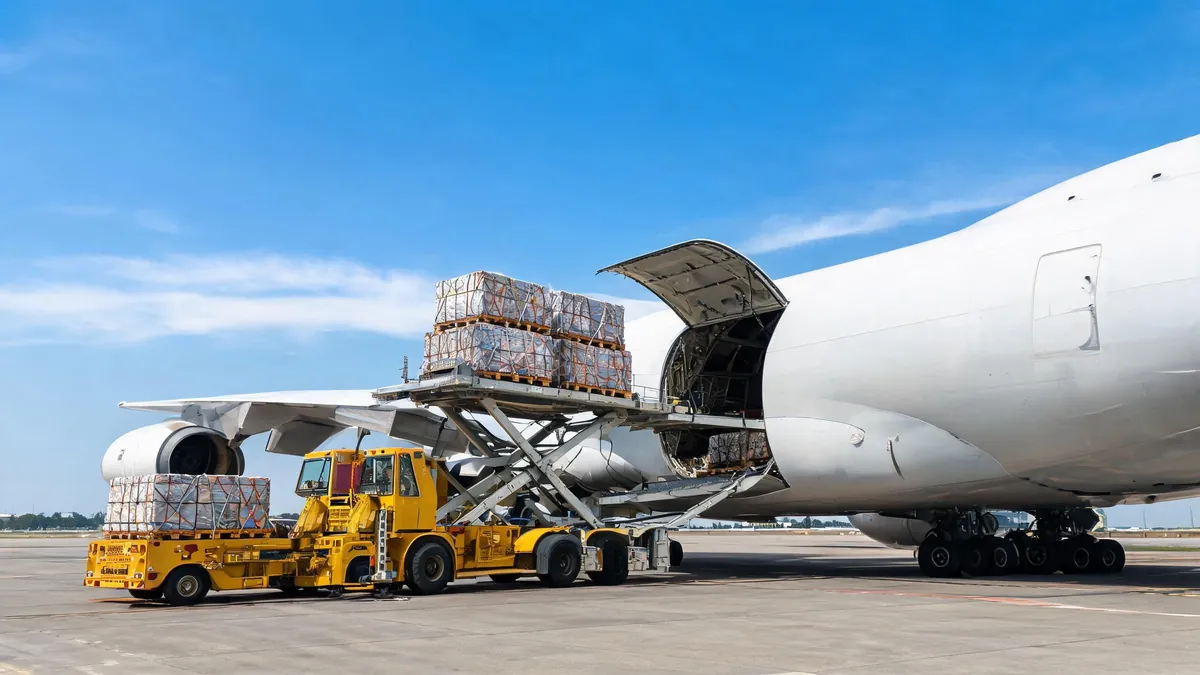
Air freight moves your cargo on commercial aircraft, consolidated with other shippers’ freight. It sits between courier and sea freight: faster than the ocean, slower and less expensive than courier per kilogram once your shipment is heavy enough.
When Air Freight Makes Sense
Air freight is the tool for orders that are too heavy for courier to be economical but too urgent to wait for a ship. Seasonal products that must arrive before a launch date, a restock that ran low, or high-value goods where you do not want capital tied up on the water for weeks are the classic cases.
There is a practical weight band where air freight shines: roughly above where courier gets expensive and below where sea freight’s volume savings kick in. For many ecommerce sellers, that band covers exactly the kind of replenishment order they place every few weeks.
How Air Freight Pricing Works
Air freight is quoted per chargeable kilogram, which — like courier — is the greater of actual weight and volumetric weight. There is usually a minimum chargeable weight, so very small shipments do not get the air freight rate advantage. On top of freight you typically pay origin handling, destination handling, and customs clearance fees, which is why air freight only makes financial sense above a certain weight threshold.
Unlike courier, air freight generally does not include last-mile delivery in the base quote. The cargo arrives at an airport, and getting it to your door is either a separate arrangement or bundled by a forwarder. That extra step is easy to miss when comparing an air freight quote against a courier’s door-to-door price.
Sea Freight: The Cheapest Way to Move Volume
Sea freight is what most serious importers graduate to. Containers move enormous weight for a fraction of the per-kilogram cost of air, at the price of time: transit is measured in weeks, not days, and the process has more moving parts.
FCL vs LCL: Full Container or Share One
Sea freight splits into two modes. Full container load (FCL) means you book an entire container for your goods. Less than container load (LCL) means your cargo shares a container with other shippers and you pay only for the space you use. FCL becomes cheaper per unit once your volume is large enough; LCL is the entry point for smaller buyers who are not ready to fill a container.
| FCL (full container) | LCL (shared container) | |
|---|---|---|
| Best for | Large, consistent volumes | Small-to-mid orders that cannot fill a container |
| Cost per unit | Lower at high volume | Higher per unit, no full-container cost |
| Transit time | Often more predictable | May include consolidation/dwell time |
| Handling | Your goods alone in the box | Shared space, more touchpoints |
| Control | Full control of loading | You share the container with others |
When Sea Freight Makes Sense
Sea freight wins when you are moving weight and can plan ahead. If your product is dense, low-value per kilogram, or you are building recurring inventory, the savings are dramatic. The trade-off is lead time and the need to coordinate more steps — which is precisely where working with an agent or forwarder earns its keep.
Dense, non-perishable goods — hardware, furniture, textiles, machinery — are the natural sea freight candidates. Fragile time-sensitive electronics or fast fashion that loses value each week may justify air instead, even at a higher per-kilogram cost.
How to Choose: A Decision Framework
Rather than memorizing rates, work backward from three questions: how heavy is the shipment, how fast do you need it, and how much handling are you willing to coordinate. That usually resolves the choice quickly.
| Your situation | Usually the right method |
|---|---|
| Small sample, first order, or urgent single item | Express courier |
| Mid-weight, time-sensitive, too heavy for courier | Air freight |
| Heavy or bulky, low urgency, cost-driven | Sea freight (LCL first, FCL at volume) |
| Orders from many suppliers that need combining | Consolidate first, then ship by the best mode |
The fourth row matters more than most new buyers realize. When you buy from several 1688 suppliers, shipping each supplier’s parcel separately is usually the most expensive possible approach. Consolidating everything into one shipment before choosing the freight mode is often where the real savings appear.
Transit Time: What to Actually Expect
Transit times are ranges, not promises, because they depend on the route, the carrier, the season, and how smoothly customs clears. Still, it helps to have a realistic mental model rather than the optimistic number a sales page might imply.
| Method | Typical transit (major routes) | What can stretch it |
|---|---|---|
| Express courier | A few days | Customs holds, remote delivery zones |
| Air freight | Roughly a week plus handling | Airport congestion, clearance delays |
| Sea freight (LCL) | Several weeks | Consolidation dwell, port congestion |
| Sea freight (FCL) | Several weeks | Vessel schedule, port congestion |
The lead-time lesson is simple: leave buffer for the parts you do not control. A shipment that is “usually a week” can take two if customs decides to inspect it, and promising your customer a date based on the best case is how new importers get burned.
Volumetric Weight: Why Bulky Items Cost More
Volumetric (or dimensional) weight is the reason a box of pillows costs more to fly than a box of bolts that weighs the same. Carriers charge for the space your parcel occupies, not just its mass, because aircraft and trucks have a finite volume. The calculation compares actual weight against a volume-based equivalent and bills the higher one.
The practical takeaway is not to memorize the formula — it varies slightly by carrier — but to recognize the pattern: light, bulky goods ship poorly by air and courier. If your product is low-density, sea freight becomes even more attractive, and compact, dense goods travel relatively cheaply by air. Ask your shipper to confirm the chargeable weight before you commit, because it can differ meaningfully from the physical weight on the label.
The Hidden Costs That Change the Real Price
The headline freight rate is never the full price of shipping from China. A handful of items routinely sit outside the quoted figure, and knowing them in advance prevents a nasty surprise on the bill.
- Customs duties and import tax — charged by your own country on arrival, and generally your responsibility unless you explicitly ship under DDP terms.
- Fuel and security surcharges — fluctuate over time and are added to base freight.
- Origin and destination handling — terminal fees, documentation fees, and warehouse handling at both ends.
- Customs clearance fees — the cost of preparing and lodging the import declaration.
- Last-mile delivery — getting the goods from the arrival port or airport to your actual address.
This is why a “cheap” freight quote can quietly become expensive, and why comparing only the per-kilogram number is misleading. A complete quote should itemize the full door-to-door path, not just the transit leg. Destination-country duties and compliance remain the buyer’s responsibility unless your shipping is arranged under terms that include them.
Paperwork You Will Need
International shipping runs on documents, and most delays trace back to a missing or incorrect one. The exact set varies by destination and product, but a few core documents appear in nearly every shipment.
- Commercial invoice — describes the goods, their value, and the buyer and seller; this is what customs uses to assess duty.
- Packing list — itemizes weights, dimensions, and contents so the shipment can be checked.
- Bill of lading or air waybill — the transport document that acts as the contract of carriage and proof of shipment.
- Export/import declarations — filed with the respective customs authorities.
- Certificate of origin — sometimes required, and can affect duty rates under trade agreements.
If this list feels like more than you want to manage, that is a legitimate reason to route the order through an agent or forwarder who prepares these documents as part of the service. The freight cost is only part of what you are paying for; the paperwork and the mistakes it prevents are the other part.
Where a China Buying Agent Changes the Math
A buying agent’s value in shipping is not that it makes freight free — it is that it removes the coordination and the pricing blind spots. When you work through a China buying agent, the agent can combine orders from multiple suppliers into one shipment before the goods ever reach a carrier, which is often the difference between paying several small-parcel courier charges and one efficient consolidated freight bill.
The agent also knows which mode actually fits your order. A buyer who has never imported is prone to overpaying for air freight on something that could have gone by sea, or choosing courier for a shipment that should have been consolidated. Getting that decision right the first time routinely saves more than the agent’s fee. If you are starting with a full order rather than a single parcel, the complete order-to-door process walks through how the pieces fit together, and combining multiple 1688 sellers into one shipment is where consolidation savings come from.
Common Mistakes That Cost First-Time Importers
- Paying for weight you do not ship. Volumetric weight catches light, bulky products — ask for the chargeable weight before committing.
- Shipping each supplier separately. Multiple small parcels are the most expensive way to move goods; consolidation is almost always cheaper.
- Comparing only the freight line. Surcharges, handling, duties, and last-mile delivery are real costs — get an itemized door-to-door figure.
- Ignoring lead time. The cheapest method that misses your launch window is not actually cheap.
- Forgetting destination compliance. Your country’s duties and import rules are your responsibility under most terms.
- Using the wrong Incoterm. Shipping without understanding whether duties are included (DDP) or yours to pay (DAP) is a common source of shock at the door.
Frequently Asked Questions
What is the cheapest way to ship from China?
Sea freight is almost always the cheapest per kilogram for heavy or bulky orders, followed by air freight for mid-weight shipments and express courier for small, light parcels. The cheapest overall option depends on your shipment’s weight, volume, and how fast you need it — and combining orders from multiple suppliers before shipping often saves more than switching carriers.
How long does shipping from China take?
It ranges from roughly a few days for express courier on major routes, to a week or more for air freight including handling, to several weeks for sea freight depending on the destination and whether the goods move FCL or LCL. Actual times vary with the carrier, route, season, and customs, so treat these as ranges rather than guarantees.
What is the difference between DDP and DAP?
Under DAP (Delivered at Place) the seller delivers to a named destination but the buyer is responsible for import duties and clearance. Under DDP (Delivered Duty Paid) the seller or shipper covers those import costs. If you want a true all-in door-to-door price, DDP is the term to ask about — see DDP shipping explained for the full detail.
How are shipping costs from China calculated?
Freight is calculated on chargeable weight (the higher of actual and volumetric weight) for courier and air, and on container space or volume for sea. Added on top are fuel and security surcharges, origin and destination handling, customs clearance, and last-mile delivery, plus destination-country duties where they apply.
Do I need a freight forwarder to ship from China?
Not for small courier parcels, but as shipments grow, a forwarder or buying agent becomes valuable for consolidating suppliers, preparing documents, and choosing the right freight mode. Many buyers route mid-to-large orders through an agent specifically to avoid coordinating these steps themselves.
Should I ship by air or sea for my order?
Use air when the goods are time-sensitive, high-value, or too light to justify sea freight’s lead time. Use sea when the goods are heavy, low-value per kilogram, or not urgent. The crossover point is your chargeable weight against the value of getting the goods sooner, so a specific order needs a specific comparison.

Get an Itemized Shipping Quote for Your Order
Shipping from China does not have to be a guessing game. If you tell us what you are buying, its rough weight and dimensions, and your destination, we can map the realistic options — courier, air, or sea — with the full door-to-door picture, not just a headline rate. If your order comes from several suppliers, we can also consolidate it first so you are not paying to ship a pile of separate parcels.
Start with the details of your shipment on our shipping page, or contact us for a quote on your specific order. Destination-country duties and import compliance remain your responsibility unless your shipment is arranged under terms that include them.